
Myrosinase: The Enzyme That Decides Whether Your Sulforaphane Supplement Works
Myrosinase is the enzyme that cuts glucoraphanin into sulforaphane. In human testing, preparations with active myrosinase delivered about 40–41.8% of the dose as absorbed sulforaphane, against about 9.4–11.5% without it, so an active enzyme source on the label is the line to check.
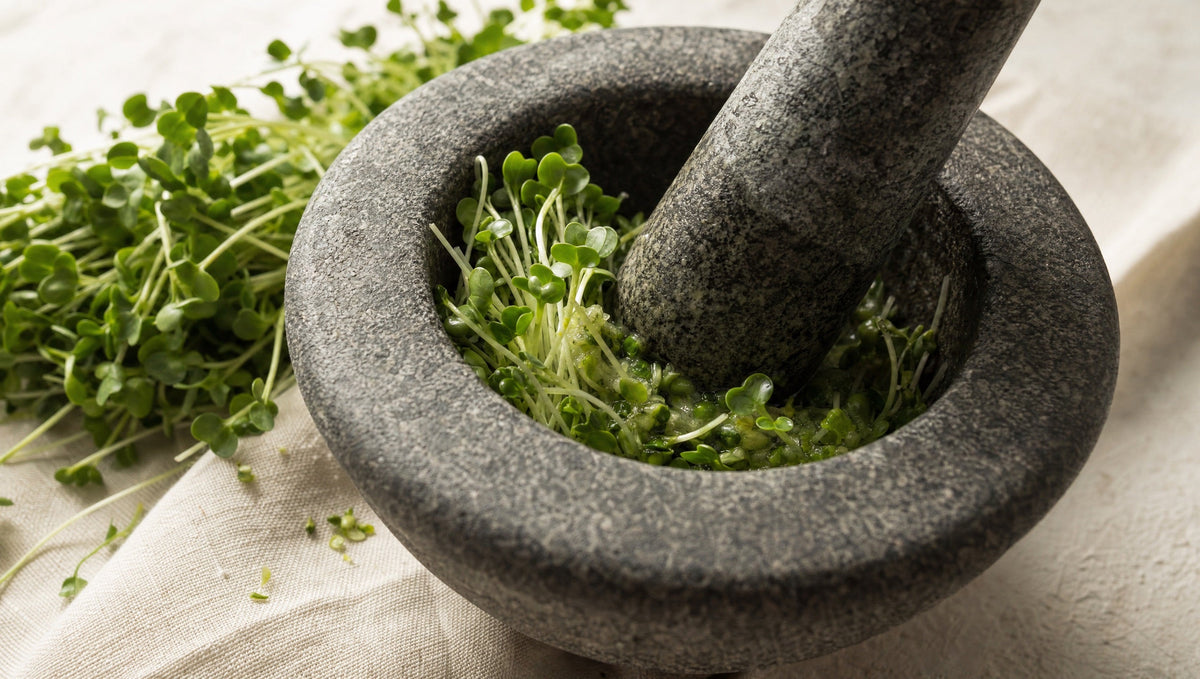
Sulforaphane is made, not stored, and myrosinase is the enzyme that makes it. Glucoraphanin is what sits in the capsule, and it stays inert until that enzyme cuts it into sulforaphane. In human testing, glucoraphanin-rich preparations without active myrosinase delivered about 9.4–11.5% of the dose as absorbed sulforaphane, while preparations carrying the active enzyme delivered about 40–41.8%1. Whether a panel names an active enzyme source is the one line on a label that speaks to that difference.
- Glucoraphanin-rich preparations lacking active myrosinase delivered about 9.4–11.5% of the dose as absorbed sulforaphane; preparations that carried the active enzyme delivered about 40–41.8%, three to four times more1.
- Heat destroys myrosinase: raw broccoli produced 37% sulforaphane bioavailability against 3.4% for cooked broccoli in a human feeding study, with peak plasma time pushed from 1.6 hours to 6 hours2.
- When a product supplies no myrosinase, gut bacteria do the conversion at wildly different rates: the same 200 g of cooked broccoli produced 24-hour urinary isothiocyanate outputs of 1.2 to 34.7 µmol across 23 adults, a roughly thirty-fold spread3.
- Adding 1 g of powdered brown mustard, a myrosinase source, to cooked broccoli raised sulforaphane bioavailability up to roughly eight-fold in a randomised crossover of 12 adults4.
- A 2026 randomised crossover measured 39.8% bioavailability for a broccoli seed extract taken with mustard-seed myrosinase against 18.6% for the same extract alone — a single-dose design in 16 people, funded by the maker of the glucoraphanin ingredient it tested5.
What is myrosinase? Myrosinase is the enzyme that cuts glucoraphanin into sulforaphane. In an intact plant it is stored away from the compound it acts on6. What it is and where it sits.
Does heat destroy myrosinase? Heat removes it, and the loss shows up in people: raw broccoli gave 37% sulforaphane bioavailability against 3.4% for cooked broccoli in a human feeding study2. Why heat destroys myrosinase.
Does a glucoraphanin supplement need myrosinase? Yes, if you want the higher measured result: preparations with active myrosinase delivered about 40 to 41.8% of the dose as absorbed sulforaphane, against about 9.4 to 11.5% without it1. Without it, gut bacteria convert at rates that differ about thirty-fold between people3.
Where does the myrosinase in a supplement come from? From plant material that kept its enzyme: broccoli sprouts or seeds given without heat extraction1, or mustard seed, the donor in a 12-adult crossover4 and a 2026 trial of 16 people5. What adding the enzyme back does.
How can I see myrosinase on a supplement label? Look for an ingredient line that names an enzyme source, says active, and sits apart from the glucoraphanin line. Sproutly's panel lists 200 mg broccoli sprout extract carrying active myrosinase. How to see myrosinase on a supplement label.
What myrosinase is, and where it sits in a broccoli plant
Myrosinase is the enzyme that cuts glucoraphanin into sulforaphane. Glucoraphanin is a glucosinolate — a stable sulfur compound broccoli stockpiles — and sulforaphane, the isothiocyanate that does the work downstream, only exists once that cut is made.
The plant keeps the two apart. Immunocytochemical imaging of Arabidopsis and Brassica napus tissue located the enzyme exclusively in specialised idioblasts called myrosin cells, structurally distinct from the cells holding the glucosinolate store6. That is plant cell biology rather than a human finding, and it is the structural reason chewing, chopping or crushing starts the reaction: the two are in the same plant, not the same place. In vitro, crystal structures resolve the step itself — ascorbate binds the enzyme's active site and substitutes for its catalytic base during hydrolysis7.
The enzyme is not unique to broccoli. Every cruciferous vegetable carries a version of it — kale, cabbage, cauliflower, Brussels sprouts, watercress, mustard, wasabi — but broccoli and its sprouts are the most studied, which is why nearly all the human data below is broccoli-derived.
A supplement inherits the problem the plant created: if the tissue was never broken while the enzyme was alive, or the enzyme died on the way into the capsule, nothing has done the cutting yet.
In one line: myrosinase converts inert glucoraphanin into sulforaphane, and in an intact plant it is stored away from the compound it acts on6.

Read next: what sulforaphane is
Why heat destroys myrosinase
Heat removes myrosinase activity, and it does so well below boiling. In food-chemistry work on the enzyme extracted from broccoli for study — not a human trial — thermal inactivation ran across roughly 30–60 °C, and the authors described the enzyme as thermolabile8.
That is why a heat-processed extract can test rich in precursor and still convert badly: the number on the panel is intact, the machinery that acts on it is not. Drying and extraction steps sit between the field and the capsule, and none of that history appears on a label.

What happens when a supplement brings no enzyme
A glucoraphanin-only supplement, with no active myrosinase source on the panel, is not a dead end. It is a lottery. Gut bacteria perform some of the conversion, and how much they perform differs enormously between people.
When 23 adults ate the same 200 g of cooked broccoli, delivering roughly 120 µmol of glucosinolates, 24-hour urinary isothiocyanate output ranged from 1.2 to 34.7 µmol — about a thirty-fold spread on one identical dose3. High excreters averaged 23.4 ± 7.5 µmol against 5.6 ± 2.7 µmol for low excreters (p<0.01), and the same split reappeared when the highest and lowest excreters' faecal bacteria were incubated with glucoraphanin outside the body3.
That is the honest version of "your gut will handle it." Some people's bacteria do. Nothing on a label tells you which group you are in: the missing enzyme does not make a product inert, it makes its output unreadable in advance.
Read next: fresh sprouts versus a supplement
What adding the enzyme back actually does
Adding an active myrosinase source alongside glucoraphanin changes the measured result, and four human datasets point the same way.
The anchor study compared preparations that differed by enzyme rather than by format: about 9.4–11.5% of a 100 µmol dose absorbed without the active enzyme, about 40–41.8% with it, three- to four-fold more1.
Food gives the same signal. In a randomised crossover of 12 adults, 1 g of powdered brown mustard stirred into cooked broccoli raised sulforaphane bioavailability up to roughly eight-fold, with urinary metabolites up about four-fold4. A four-subject pilot using air-dried broccoli sprout powder as the enzyme donor moved the same way9 — n=4, so it corroborates rather than proves.
The most recent trial tested the supplement version of the question. A randomised, double-blind crossover published in 2026 measured 39.8 ± 3.1% bioavailability when a glucoraphanin-rich broccoli seed extract was taken with mustard-seed myrosinase, against 18.6 ± 3.1% for the same extract alone; first-eight-hour conversion was 25.4 ± 2.7% versus 8.0 ± 2.7%5. Three qualifiers travel with those numbers wherever they are quoted: the design was single-dose, so it says nothing about weeks of daily use; the sample was 16 people; and the study was funded by the company that makes the glucoraphanin ingredient it tested, with one author employed there and one a paid consultant5. The person-to-person ranges were wide in both arms — 5.3–76.9% with the enzyme and 2.2–38.1% without5.
From Sproutly
Why an enzyme on the label is still not a guarantee
An enzyme on the label is not the same as a completed conversion, because the reaction has more than one exit. In recombinant-protein work — plant biochemistry in vitro, not a human study — an epithiospecifier protein isolated from broccoli redirected myrosinase-catalysed hydrolysis of glucoraphanin toward sulforaphane nitrile in place of sulforaphane, and that protein's activity was inversely correlated with how much sulforaphane formed10.
That is a mechanism, not a measurement of any capsule. No human trial has quantified how much of a finished supplement's glucoraphanin takes the nitrile exit. Treat it as the reason the story is not simply "more enzyme, more sulforaphane" — not as a product advantage, and not as something any panel discloses.
The human evidence in one table
| Study | Design and n | What was compared | Measured result | What it does not say |
|---|---|---|---|---|
| Fahey et al. 20151 | Crossover, n=5 core subjects, extended to n=22 for the supplement comparison | Glucoraphanin-rich preparations with and without active myrosinase | About 9.4–11.5% of dose absorbed without the active enzyme; about 40–41.8% with it | Anything beyond absorption; no repeat dosing |
| Okunade et al. 20184 | Randomised crossover, n=12 | 200 g cooked broccoli alone versus with 1 g powdered brown mustard | Bioavailability up to about eight-fold higher; urinary metabolites about four-fold higher | Whether a capsule behaves like food; no dose-response arm |
| Mastaloudis et al. 20265 | Randomised, double-blind, single-dose crossover, n=16; funded by the maker of the glucoraphanin ingredient, one author employed there and one a paid consultant | A glucoraphanin-rich broccoli seed extract alone versus the same extract with mustard-seed myrosinase | 39.8 ± 3.1% versus 18.6 ± 3.1%; individual ranges 5.3–76.9% and 2.2–38.1% | Anything about daily use over weeks — single dose only, n=16, industry-funded |
| Vermeulen et al. 20082 | Human feeding study, raw versus cooked broccoli | The same vegetable with the converting enzyme intact or heat-inactivated | 37% versus 3.4% bioavailability; peak plasma 1.6 h versus 6 h | Which processing step in a supplement counts as "cooked" |
| Li et al. 20113 | Feeding study plus ex vivo faecal incubation, n=23 (10 selected) | One identical 200 g cooked broccoli dose across different people | 24-hour output 1.2–34.7 µmol; high versus low excreters 23.4 ± 7.5 versus 5.6 ± 2.7 µmol | Why an individual lands where they do, or how to predict it in advance |
Enzyme-inclusive and glucoraphanin-only formulas, compared
Enzyme-inclusive and glucoraphanin-only formulas differ on one line of the panel, and that line decides which step still has to happen inside you. No trial has run these approaches against each other, so the rows below are read from separate studies rather than one comparison11.
| Approach | What the label shows | What still has to happen inside you | What the human data says | What is not known |
|---|---|---|---|---|
| Glucoraphanin-only formulas | Glucoraphanin, or a standardised broccoli seed extract, with no enzyme source named | The whole conversion, performed by gut bacteria | About 9.4–11.5% of dose absorbed without the active enzyme1; a roughly thirty-fold conversion spread between people3 | Where any individual sits inside that spread3 |
| Enzyme-inclusive formulas | Glucoraphanin plus a separately declared active myrosinase source | Nothing extra, provided the enzyme survived processing | About 40–41.8% with the active enzyme1; 39.8% versus 18.6% in a single-dose crossover of 16, industry-funded5 | Whether a given capsule's enzyme is still active — no panel states it |
| Pre-converted or stabilised sulforaphane | Sulforaphane itself, already formed before packaging | Absorption only; the conversion happened in the factory | A pre-hydrolysed beverage recovered about 70% of dose in 24-hour urine against about 5% for a glucoraphanin-rich one, in a randomised crossover of 50 adults12 | How it compares against an enzyme-inclusive formula — no head-to-head trial exists11 |
| Fresh sprouts as food | No panel at all | Chewing has to break the tissue while the enzyme is intact | Fresh sprouts produced 7-fold higher peak plasma sulforaphane and 5-fold higher 24-hour urinary excretion than a broccoli supplement in the same 12 subjects13 | The glucoraphanin content of any given tray |
Read next: how to choose a sulforaphane supplement
How to see myrosinase on a supplement label
A supplement label answers the enzyme question in four lines, if you know which four to read.
Is an enzyme source named at all? Front-of-pack wording is not the test. The Supplement Facts panel either carries an ingredient line that supplies the converting enzyme, or it does not.
Does it say active? "Contains myrosinase" and "contains active myrosinase" are different statements, and only the second one describes an enzyme that can still work. Processing adjectives on the front of a pack describe a method nobody outside the factory can check.
Is the enzyme on its own ingredient line? An enzyme source listed separately from the glucoraphanin source is a stated fact with an amount attached. An enzyme implied by the word "sprout" somewhere in a blend is not.
Is there a serving size to hold the numbers against? Milligram figures mean nothing until you know how many capsules deliver them.
Worked example, read off one panel. Sproutly's Supplement Facts panel lists 700 mg broccoli seed extract standardised to 13% glucoraphanin, 200 mg broccoli sprout extract carrying active myrosinase, 100 mg mustard seed extract and 50 mg ascorbic acid, in a two-capsule serving, 30 servings per pouch. The sprout extract is the line the panel assigns the active enzyme to, so the conversion step has a named source rather than an implied one. Mustard seed is listed separately and the panel states no mechanistic role for it; what can be said is that mustard seed was the enzyme donor in the 12-person crossover and in the industry-funded, single-dose 2026 trial of 164,5. The panel also claims "Up to 30mg sulforaphane per serving" — the label's own claim, not a bioavailability measurement.
And the limit worth saying out loud: no peer-reviewed analytical survey compares label claims against measured content across commercial products14. A panel tells you what a formula intends. It does not tell you what a capsule delivered.

If you want to see those four lines on a real panel before comparing anything else:
What a myrosinase claim cannot tell you
A myrosinase claim on a panel is a statement of intent, and four things are missing from it.
Activity is not quantified. Enzyme activity has units, and panels in this category almost never declare them: "active" tells you the ingredient is present, not how much work it can do. No peer-reviewed survey measures what any panel here claims14.
Nothing has been compared head to head. No trial has run an enzyme-inclusive formula against a pre-converted one11, so any ranking between them is reasoning rather than evidence.
Single-dose trials do not describe weeks. The 2026 crossover measured one dose in 16 people and was industry-funded5. Daily use over weeks was not tested, by that trial or any other on this page.
Individual response stays wide even when the label is right. Bioavailability ranged from 5.3% to 76.9% inside the enzyme arm of the single-dose, industry-funded trial of 165, and the thirty-fold spread among people relying on their bacteria was measured separately3.
The bottom line
Myrosinase is the step, not the extra. A formula that supplies the precursor and no enzyme hands the conversion to bacteria that differ enormously between people; a formula naming an active enzyme source on its own ingredient line has done the part it can control. That is the criterion to carry to any shelf: find the enzyme line, check it says active, check it sits apart from the glucoraphanin line, and check the serving size the amounts refer to. Everything past that — activity units, head-to-head comparisons, what happens across weeks — has not been measured, and a label implying otherwise is ahead of the evidence.
Four ingredients, one panel, and the conversion step named on its own line.
Frequently Asked Questions
Does cooked broccoli still contain sulforaphane?
Cooked broccoli still contains glucoraphanin; what it mostly lacks is myrosinase, the enzyme that converts it. Raw broccoli produced 37% bioavailability against 3.4% for cooked in a human feeding study2, and the laboratory inactivation range for the broccoli enzyme is roughly 30–60 °C8. Gut bacteria still convert some of it, at rates differing about thirty-fold between people3.
Do I need an enzyme-inclusive supplement if I eat fresh broccoli sprouts?
Fresh sprouts arrive with their own myrosinase intact, which is why they outperformed a broccoli supplement in the same 12 subjects: 7-fold higher peak plasma sulforaphane and 5-fold higher 24-hour urinary excretion13. What sprouts do not give you is a stated amount.
Does the mustard seed in a formula have to be raw?
It has to have kept its myrosinase, which is a processing question rather than a raw-versus-cooked one. In the trial that measured the effect the donor was 1 g of powdered brown mustard, and it worked in that form4. Heat is what removes the activity, in the human feeding data and in the laboratory work alike2,8.
Can a bigger glucoraphanin dose make up for a missing enzyme?
No trial has tested that substitution, so it is insufficient data. The enzyme changes what fraction of a dose converts1; the dose changes how much is available to convert. Multiplying an unpredictable fraction3 by a larger number leaves it unpredictable.
Read next: more supplement questions
References
- Fahey JW, et al. 2015. PLoS One. Crossover, n=5 core subjects, extended to n=22 for the supplement comparison. Glucoraphanin-rich preparations lacking active myrosinase delivered about 9.4–11.5% of a 100 µmol dose as absorbed sulforaphane; preparations containing active myrosinase delivered about 40–41.8%, described by the authors as three- to four-fold more bioavailable. PMID 26524341 · https://doi.org/10.1371/journal.pone.0140963
- Vermeulen M, et al. 2008. J Agric Food Chem. Human feeding study, raw versus cooked broccoli. Sulforaphane bioavailability 37% raw versus 3.4% cooked; peak plasma time 1.6 h versus 6 h. PMID 18950181 · https://doi.org/10.1021/jf801989e
- Li F, Hullar MAJ, Beresford SAA, Lampe JW. 2011. Br J Nutr. Feeding study plus ex vivo faecal incubation, n=23 (10 selected as high and low excreters). 24-hour urinary isothiocyanate output 1.2–34.7 µmol after 200 g cooked broccoli (about 120 µmol glucosinolates); high versus low excreters 23.4 ± 7.5 versus 5.6 ± 2.7 µmol (p<0.01); ex vivo glucoraphanin degradation 13.3 ± 5.9% versus 5.6 ± 4.8% over 48 h (p=0.05). PMID 21342607 · https://doi.org/10.1017/S0007114511000274
- Okunade O, et al. 2018. Mol Nutr Food Res. Randomised crossover, n=12 healthy adults. 200 g cooked broccoli plus 1 g powdered brown mustard raised sulforaphane bioavailability up to about eight-fold versus cooked broccoli alone, with urinary SFN-NAC about four-fold higher. PMID 29806738 · https://doi.org/10.1002/mnfr.201700980
- Mastaloudis A, Holcomb L, Fahey JW, et al. 2026. Sci Rep. Randomised, double-blind, single-dose crossover, n=16 (9 female, 7 male). Bioavailability 39.8 ± 3.1% (range 5.3–76.9%) for a glucoraphanin-rich broccoli seed extract taken with mustard-seed myrosinase versus 18.6 ± 3.1% (range 2.2–38.1%) for the extract alone; first-eight-hour conversion 25.4 ± 2.7% versus 8.0 ± 2.7%. PMID 41692762 · https://doi.org/10.1038/s41598-026-39389-4
- Andréasson E, et al. 2001. Plant Physiology. Immunocytochemical and confocal localisation in Arabidopsis and Brassica napus tissue. PMID 11743118 · https://doi.org/10.1104/pp.010334
- Burmeister WP, et al. 2000. J Biol Chem. X-ray crystallography — in vitro structural biochemistry. PMID 10978344 · https://doi.org/10.1074/jbc.M006796200
- Ludikhuyze L, et al. 1999. J Agric Food Chem. Enzyme-kinetics study on myrosinase extracted from broccoli. Thermal inactivation proceeds across 30–60 °C. PMID 10552454 · https://doi.org/10.1021/jf980964y
- Cramer JM, Jeffery EH. 2011. Nutrition and Cancer. Pilot, n=4. Air-dried broccoli sprout powder used as a myrosinase donor. https://doi.org/10.1080/01635581.2011.523495
- Matusheski NV, et al. 2006. J Agric Food Chem. Recombinant-protein plant biochemistry, in vitro. PMID 16536577 · https://doi.org/10.1021/jf0525277
- Evidence gap. No human trial was located that compares a pre-converted or stabilised sulforaphane product head to head against a glucoraphanin-plus-myrosinase product.
- Egner PA, et al. 2011. Cancer Prev Res. Randomised crossover, n=50. About 70% of dose recovered in 24-hour urine from a pre-hydrolysed sulforaphane beverage versus about 5% from a glucoraphanin-rich, myrosinase-poor beverage. PMID 21372038 · https://doi.org/10.1158/1940-6207.CAPR-10-0296
- Clarke JD, et al. 2011. Pharmacological Research. Crossover, n=12. Fresh broccoli sprouts produced 7-fold higher peak plasma sulforaphane and 5-fold higher 24-hour urinary excretion than a broccoli supplement. PMID 21816223 · https://doi.org/10.1016/j.phrs.2011.07.005
- Evidence gap. No peer-reviewed analytical survey comparing label claims against measured content across commercial products was located.
What customers say
About this article
Written by the Sproutly editorial team. Sproutly sells a broccoli sprout extract supplement, and this article links to its product page.
This is general information, not medical advice. Check your own label and ask a pharmacist or doctor about your situation.
These statements have not been evaluated by the Food and Drug Administration. This product is not intended to diagnose, treat, cure, or prevent any disease.
Keep reading
 Sulforaphane 101
Sulforaphane Bioavailability: Why Most Supplements Never Become Sulforaphane, and How to Check Yours
 Sulforaphane 101
Sulforaphane for Detox: How NRF2 Activation Fights Microplastics, BPA & Environmental Toxins
 Sulforaphane 101