
Sulforaphane Bioavailability: Why Most Supplements Never Become Sulforaphane, and How to Check Yours
Sulforaphane bioavailability is the share of a dose that reaches your blood as sulforaphane. In a human crossover, about 10% of a glucoraphanin dose was recovered without active myrosinase and about 40% with it, so the enzyme line on a label matters more than the milligrams.
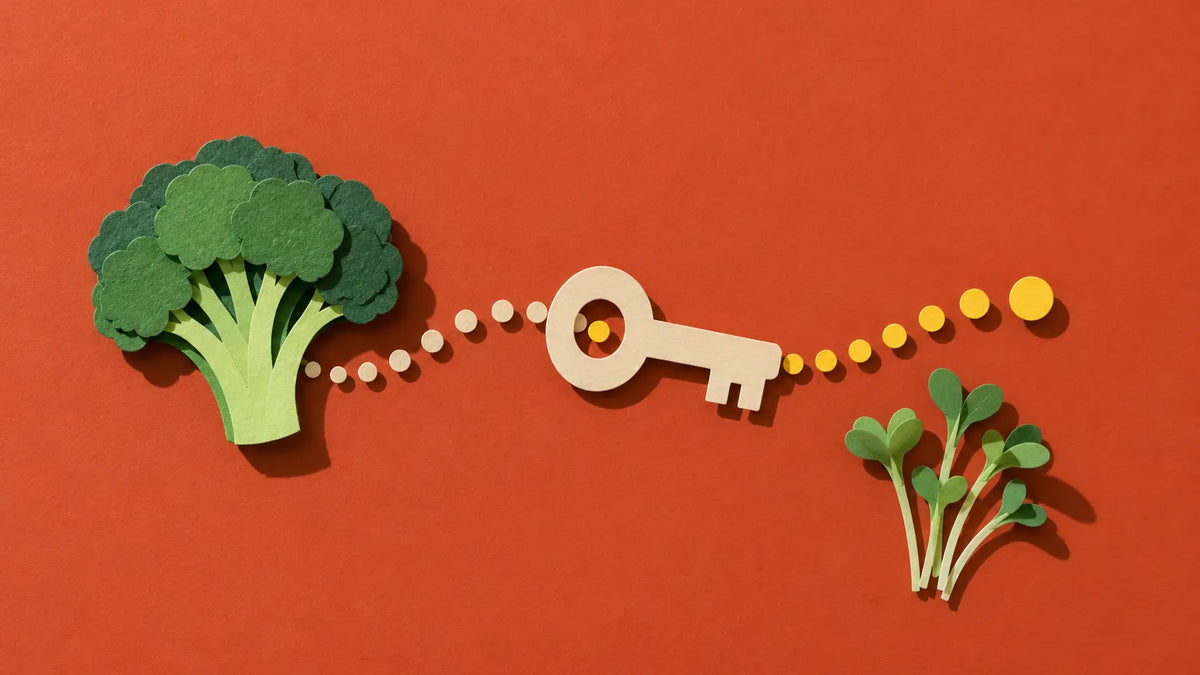
Sulforaphane is not what is inside most sulforaphane supplements. Glucoraphanin is, and glucoraphanin is inert until the enzyme myrosinase converts it. In human testing, preparations without active myrosinase delivered about 9.4–11.5% of the dose as absorbed sulforaphane, while preparations with active myrosinase delivered about 40–41.8%1. That single missing step, not capsule quality or brand tier, is what separates a supplement that converts from one that mostly passes through.
- Without active myrosinase, glucoraphanin-rich preparations delivered roughly 9.4–11.5% of the dose as absorbed sulforaphane; with active myrosinase included, roughly 40–41.8%1.
- A randomised crossover in 50 adults recovered about 70% of the dose in urine from a pre-converted sulforaphane beverage versus about 5% from a glucoraphanin-rich one2.
- Adding 1 g of powdered brown mustard, a myrosinase source, to cooked broccoli raised sulforaphane bioavailability up to eight-fold in a randomised crossover of 12 adults3.
- Cooking destroys the myrosinase that drives the conversion: raw broccoli produced 37% bioavailability versus 3.4% cooked, with peak plasma pushed from 1.6 hours to 6 hours4.
- Identical doses land very differently between people: 200 g of cooked broccoli produced 24-hour urinary isothiocyanate outputs ranging from 1.2 to 34.7 µmol across subjects5.
What is the half-life of sulforaphane? About 1.8 hours in plasma, in four people given broccoli sprout isothiocyanates6. Urinary excretion half-life was 2.4 to 2.6 hours in eight men after a broccoli meal4.
When is the best time to take sulforaphane? There is no proven best time: no trial has compared morning with evening dosing7. Pre-formed sulforaphane peaks about an hour after a dose and clears within hours6. Take it at the time you will keep.
Does cooking destroy sulforaphane? Cooking mostly stops it forming, because heat destroys myrosinase, the enzyme that makes it. In people, raw broccoli gave 37% bioavailability against 3.4% for cooked4. Steaming for 1 to 3 minutes gave more than boiling or microwaving in lab tests8.
Does freezing destroy it? Commercial freezing does: blanching before freezing destroys myrosinase, and in 18 people frozen broccoli gave about a tenth of the sulforaphane bioavailability of fresh9.
What raises absorption most? Active myrosinase in the product: preparations with it were three- to four-fold more bioavailable than those without1. The levers that change absorption.
What bioavailability means for sulforaphane
Bioavailability, for sulforaphane specifically, is not a general absorption score. It is one measurement: the share of an administered dose recovered as sulforaphane and its mercapturic-acid metabolites in urine over the 24 hours after the dose. That endpoint is the field's working convention, applied consistently across independent research groups1,2,4,6.
Sulforaphane arrives fast and leaves fast. In four healthy volunteers given 200 µmol of broccoli sprout isothiocyanates, peak plasma concentrations of 0.943–2.27 µmol/L appeared roughly one hour after the dose, and elimination followed first-order kinetics with a half-life of 1.77 ± 0.13 hours6.
In one line: sulforaphane bioavailability is the percentage of a dose that reaches circulation as sulforaphane and is recovered as measurable metabolites within 24 hours, not the amount of glucoraphanin the capsule contained1,6.
Read next: what sulforaphane is
Glucoraphanin, myrosinase, and the conversion step
Glucoraphanin is the storage form. It is a stable glucosinolate found in broccoli, broccoli sprouts, and nearly every broccoli-derived supplement on the shelf, and on its own it does very little, because intact glucosinolates are far less bioavailable than the isothiocyanates they become after hydrolysis10. Myrosinase is the enzyme that performs that hydrolysis, cutting glucoraphanin into sulforaphane. Think of the two as a match and the strip on the side of the box: kept apart, nothing happens; brought together, the reaction is immediate.
In an intact plant the two sit in separate cell compartments; chewing, chopping or crushing is what brings them together, and a supplement has to do that job for you.
When active myrosinase is present, human bioavailability of sulforaphane reached about 40–41.8% of a 100 µmol dose; when it was absent, the same measurement fell to about 9.4–11.5%1. A second randomised crossover, in 50 adults, drew the line even more sharply: about 70% of the dose recovered from a pre-hydrolysed sulforaphane beverage versus about 5% from a glucoraphanin-rich one2.
A glucoraphanin-only product is not a dead end — your gut bacteria do some of the conversion, just inconsistently, across a roughly thirty-fold range between people5.
Supplying the enzyme alongside the precursor changes the outcome: adding 1 g of powdered brown mustard to cooked broccoli increased sulforaphane bioavailability up to roughly eight-fold in a randomised crossover of 12 adults3, and a four-subject pilot using air-dried broccoli sprout powder as the donor points the same way11.
A February 2026 randomised crossover in 16 adults, published in Scientific Reports, found sulforaphane bioavailability of 39.8% when a glucoraphanin-rich broccoli seed extract was paired with mustard-seed myrosinase, against 18.6% for the same extract alone12. The person-to-person range was wide in both arms, 5.3–76.9% and 2.2–38.1%12. Three qualifiers travel with those figures: the design was single-dose, so it says nothing about daily use over weeks; the sample was 16 people; and the study was primarily funded by the company that makes the glucoraphanin ingredient it tested, with one author employed there and one a paid consultant12.

The three forms of sulforaphane in supplements
Sulforaphane supplements come in three structurally different forms, and the difference decides which step has to happen inside you and which one already happened in the factory.
Glucoraphanin only. Glucoraphanin-only supplements supply the precursor with no enzyme alongside it. Conversion then depends entirely on your gut bacteria, which vary enormously between people5, and this is the form that produced the low end of the bioavailability range in human testing1,2.
Glucoraphanin plus a myrosinase source. Glucoraphanin paired with a myrosinase source supplies the precursor and the active enzyme together, usually as broccoli sprout material or mustard seed. This pairing has the strongest supporting human data of the three: mustard powder raised bioavailability up to roughly eight-fold in a randomised crossover3, and preparations containing active myrosinase were three- to four-fold more bioavailable than those without1.
Stabilised, pre-converted sulforaphane. Stabilised sulforaphane is sulforaphane itself, preserved in the product rather than generated in your gut. What does not exist is a head-to-head human trial of a stabilised sulforaphane product against a glucoraphanin-plus-enzyme product; the nearest study puts a stabilised sulforaphane through a placebo-controlled pharmacokinetic trial with no glucoraphanin arm to compare it against13. Anyone ranking those two against each other is reasoning, not citing.
Synthetic sulforaphane is a fourth category, used in research. No human trial has compared it with plant-derived sulforaphane in the same subjects, or in a matched cohort under one protocol, so this page makes no claim about the two14.
Comparing supplement forms: capsule, powder, and liquid
Capsules, powders, and liquids are delivery formats, not conversion strategies, and the human literature reflects that: no trial has compared them head to head for sulforaphane bioavailability7.
| Format | What it usually contains | Myrosinase status | What human data says | What to check on the label |
|---|---|---|---|---|
| Capsule | Standardised broccoli seed or sprout extract, sometimes with a separate enzyme source | Varies by formula; only stated if the maker lists an active-myrosinase ingredient | No direct human comparison of capsule versus other formats7. Fahey 2015's low and high results both came from supplement-style preparations that differed by enzyme, not format1 | A named ingredient line carrying active myrosinase, not a processing adjective |
| Powder | Milled sprout or seed material, or extract blended into a drink base | Depends on how the material was dried; heat destroys the enzyme4 | No direct human comparison7. Sprout powder has been used successfully as the myrosinase donor in a four-subject pilot11 | Whether the powder is the enzyme source, the precursor source, or both |
| Liquid | Beverage or extract, sometimes pre-hydrolysed so sulforaphane is already formed | Often irrelevant if the conversion already happened before bottling | No direct human comparison of liquid versus capsule7. A pre-hydrolysed beverage recovered about 70% of dose in urine versus about 5% for a glucoraphanin-rich beverage2 | Whether the label says sulforaphane or glucoraphanin — they are not interchangeable |
Can food alone do it?
Fresh broccoli sprouts deliver sulforaphane better than most supplements, and that deserves saying before the limits are named. In a crossover of 12 subjects, fresh sprouts produced peak plasma sulforaphane seven-fold higher and 24-hour urinary excretion five-fold higher than a broccoli supplement taken by the same people15.
Broccoli sprouts sit inside a wider family: cruciferous vegetables such as kale, cabbage, Brussels sprouts and mature broccoli all carry glucosinolates and their own myrosinase. We hold no verified comparison of glucoraphanin content across them, so treat them as one category rather than as interchangeable doses.
The limit is heat. In a human feeding study, raw broccoli gave 37% bioavailability against 3.4% for cooked, and peak plasma time slid from 1.6 hours to 6 hours as bacterial conversion replaced the plant enzyme4.
The second limit is that you cannot verify what you ate: a tray of sprouts carries no panel, and we hold no verified source for how much glucoraphanin content varies from tray to tray, so treat that as unknown. Food gets the enzyme right and the dose approximate; a formulated product can, in principle, get both right — if it includes the enzyme.
Read next: fresh sprouts versus a supplement
What cooking, freezing and chopping do to sulforaphane
Myrosinase, the enzyme that turns glucoraphanin into sulforaphane, stops working once broccoli gets hot enough.
Light heat can help. In lab tests on broccoli tissue, warming florets or sprouts to 60 °C before chopping raised the sulforaphane formed, because it switched off a second protein that otherwise turns the reaction toward sulforaphane nitrile instead. Heating florets to 70 °C and above lowered sulforaphane16. Steaming for 1 to 3 minutes gave more sulforaphane than boiling or microwaving in three of four broccoli varieties tested8.
Mustard restores formation after boiling. Boiled broccoli formed no significant sulforaphane in a lab test; stirring in powdered mustard seed afterwards brought formation back, because mustard carries its own myrosinase17. In 12 people, brown mustard powder stirred into cooked broccoli raised sulforaphane bioavailability3.
Frozen broccoli has lost its enzyme. Commercial frozen broccoli is blanched before freezing. When 18 people ate soup made from fresh or from frozen broccoli, sulforaphane bioavailability was about tenfold higher from the fresh9. In lab work, thawed frozen broccoli formed sulforaphane only when a myrosinase source was added, and 0.25% daikon radish was enough18.
Chop, then wait. In a lab stir-fry test, chopped broccoli left to stand for 90 minutes before stir-frying had 2.8 times the sulforaphane of broccoli stir-fried straight after chopping19. Ninety minutes is the only resting time that study measured.
Chewing. Sprouts chewed thoroughly led to more isothiocyanate metabolites in urine than sprouts swallowed whole: 42.4 against 28.8 µmol in a small human study10.
| Kitchen step | What happened to sulforaphane | Evidence |
|---|---|---|
| Warm to 60 °C before chopping | More sulforaphane formed | Lab, broccoli tissue16 |
| Steam 1–3 minutes | More than boiling or microwaving | Lab, 3 of 4 varieties8 |
| Boil | No significant sulforaphane formed | Lab17 |
| Boil, then add mustard powder | Formation restored | Lab17; human, 12 people3 |
| Buy commercially frozen | About a tenth of the bioavailability of fresh | Human, 18 people9 |
| Thaw frozen with 0.25% daikon | Formation restored | Lab18 |
| Chop, rest 90 minutes, stir-fry | 2.8 times more than stir-frying at once | Lab19 |
| Chew sprouts thoroughly | 42.4 vs 28.8 µmol excreted | Human, small study10 |
A capsule is not cooked at home, so what matters is whether its label names an active-myrosinase ingredient: the label section below shows where to find it.
In one line: boiling and commercial freezing remove the enzyme that makes sulforaphane; brief steaming, resting chopped broccoli before cooking, chewing well, and adding mustard or daikon each led to more sulforaphane.
From Sproutly
The levers that actually change absorption
Seven factors are routinely described as absorption levers. Four are supported by human data, one is in-vitro only, and two are not levers at all — they are explanations for why results differ.
1. Active myrosinase in the product. Active myrosinase in the product is the largest measured effect on this page. Adding a myrosinase source to a glucoraphanin source raised bioavailability up to roughly eight-fold3, and preparations containing active myrosinase reached three to four times the bioavailability of those without1. A four-subject pilot using sprout powder as the enzyme donor points the same way11.
2. Taking it with food, or with fat. Taking sulforaphane with food, or with fat, is the most repeated tip in the category and the least supported. No fed-versus-fasted human trial for sulforaphane was located in the search behind this page's sources20; the advice is inference from general absorption principles. The closest human study put broccoli sprouts into protein, lipid and fibre gels in five subjects and found the gels lowered bioavailability rather than raising it — explorative, in the authors' own word, and not statistically significant for sulforaphane20. Insufficient data. Take it with a meal if that is what keeps you consistent, not because absorption has been shown to depend on it.
3. Heat exposure. Heat exposure is an established lever, and it applies to the raw material as much as to your cooking. Raw versus cooked broccoli produced 37% versus 3.4% bioavailability in a human feeding study4.
4. A dose that clears the studied threshold. A dose that clears the studied threshold is the fourth lever, and one trial measured it directly. In a randomised placebo-controlled trial of 170 people, median 24-hour urinary sulforaphane metabolite output was 24.6 µmol at the full dose, 10.3 µmol at half dose, and 4.3 µmol at one-fifth dose. Only the full-dose group showed a statistically significant change in the detoxification biomarker the trial tracked; the half-dose and one-fifth-dose groups did not21.
5. Daily consistency. Daily consistency is not an absorption lever we can support. We have no source showing that sulforaphane absorption improves with repeated dosing, and no support for the claim that the body adapts its absorption to a schedule. Treat consistency as what makes a routine assessable over weeks rather than as an absorption mechanism.
6. Vitamin C as a cofactor. Vitamin C acts as a myrosinase cofactor in vitro, and only in vitro: crystal structures show ascorbate binding the enzyme's active site and substituting for its catalytic base22. That is structural biochemistry, not a feeding study, and no human trial of added vitamin C on sulforaphane bioavailability exists in our ledger. It belongs in a formula as a reasoned inclusion, not a promised boost.
7. Your gut bacteria. Your gut bacteria are not a lever you can pull; they are the main reason two people report different experiences on the same product5.

What the evidence says, in one table
The evidence base for sulforaphane bioavailability is small, consistent in direction, and specific about what it does not cover.
| Study | Design | n | What it measured | Finding | What it does not show |
|---|---|---|---|---|---|
| Fahey et al. 20151 | Crossover, extended for the supplement comparison | 5 core; 22 for the supplement comparison | Percentage of a 100 µmol dose recovered as sulforaphane metabolites | About 9.4–11.5% without active myrosinase; about 40–41.8% with it — three- to four-fold more bioavailable | Any outcome beyond absorption; no long-term dosing |
| Okunade et al. 20183 | Randomised crossover | 12 | Bioavailability and urinary metabolites after cooked broccoli with or without 1 g mustard powder | Up to roughly eight-fold higher bioavailability; roughly four-fold higher urinary metabolites | Capsule formulations; repeat dosing; any dose-response curve |
| Chen et al. 201921 | Randomised, placebo-controlled, placebo plus three dose levels | 170 | 24-hour urinary sulforaphane metabolites by dose, plus a detoxification biomarker | 24.6 / 10.3 / 4.3 µmol median output at full / half / one-fifth dose; only full dose reached statistical significance on the biomarker | That lower doses do nothing — only that they were not distinguishable from placebo here |
| Mastaloudis et al. 202612 | Randomised, double-blind, single-dose crossover | 16 | 24-hour bioavailability with and without a mustard seed myrosinase source | 39.8% with mustard seed versus 18.6% without; primarily funded by the ingredient's manufacturer | Anything about daily use; single-dose design only |
Dose timing: when to take sulforaphane
Dose timing for sulforaphane is where confident advice most outruns the evidence. What is established is the shape of a single dose: plasma sulforaphane peaks around one hour after intake and clears with a half-life of 1.77 ± 0.13 hours6. A dose is a short pulse, not a plateau you top up.
When the enzyme is destroyed and gut bacteria have to do the conversion instead, peak plasma time moved from 1.6 hours to 6 hours4. Once it arrived, it cleared at a similar pace either way: excretion half-lives were 2.6 hours after raw broccoli and 2.4 hours after cooked, in eight men4.
What does not exist is any human trial comparing morning against evening dosing for sulforaphane7. Recommendations to take it at breakfast because digestion is more active then are reasoning from general circadian principles, not findings from a sulforaphane trial. Insufficient data. Take it at the time you will actually keep.
How to read a supplement label for bioavailability
A supplement label answers the bioavailability question in about four lines, if you know which four.
Does an ingredient carry active myrosinase? A label should name active myrosinase as an ingredient line rather than describe it with a processing adjective. "Cold-pressed" and "low-temperature" describe a method nobody outside the factory can verify, while an enzyme named on the panel is a stated fact you can hold the maker to. This is the difference the human data is largest on1,3.
Is the headline number precursor or product? Glucoraphanin and sulforaphane are not interchangeable units, and a panel that gives one while implying the other is doing the reader's arithmetic for them.
Does the dose reach what has been studied? The dose on the panel is worth comparing against the one trial on this page with a dose-response arm, which found the full dose distinguishable from placebo and the fractional doses not21.
And what cannot be read off any label: no label tells you whether the contents match the claim. We searched for a peer-reviewed analytical survey comparing label claims against measured content across commercial sulforaphane products and did not find one23. Third-party testing documents are the only route, and they are a company-by-company matter, not a category fact.
Sproutly's own panel, as a worked example: 700 mg broccoli seed extract standardised to 13% glucoraphanin, 200 mg broccoli sprout extract carrying active myrosinase, 100 mg mustard seed extract, and 50 mg vitamin C, in a two-capsule serving, 30 servings per pouch (label). Seven hundred milligrams at 13% is 91 mg of glucoraphanin nominally in the serving, arithmetic off the panel rather than a measurement. The panel also states "Up to 30mg sulforaphane per serving"; that is the label's claim, and it is not a bioavailability figure. The sprout extract is where the active myrosinase sits, so the conversion step has a named source rather than an implied one. Mustard seed is listed alongside it; the panel assigns it no mechanistic role, and the human evidence for mustard as a myrosinase source is a 12-person crossover using mustard powder with food3, not a claim about this capsule. Vitamin C is included as a cofactor on in-vitro structural evidence22.
Read next: what independent testing showed
Read next: how to choose a sulforaphane supplement

If you want to see the four lines above on a real panel before you compare anything else:
Why people respond differently to the same dose
Individual variation in sulforaphane conversion is large, measured, and mostly bacterial. When 23 adults ate the same 200 g of cooked broccoli, delivering roughly 120 µmol of glucosinolates, 24-hour urinary isothiocyanate output ranged from 1.2 to 34.7 µmol — about 1% to 29% of the dose5.
High excreters averaged 23.4 ± 7.5 µmol per 24 hours against 5.6 ± 2.7 µmol for low excreters, and when their own faecal bacteria were incubated with glucoraphanin outside the body, the high excreters' bacteria degraded 13.3 ± 5.9% of it in 48 hours versus 5.6 ± 4.8% for the low excreters5. The difference between people was reproducible in a dish.
If a product relies on your bacteria to do the conversion, your result is a lottery someone else already ran differently. We hold no source attributing this variation to age, genetics, or medication use — those explanations circulate, but not with evidence we can cite here.
Mistakes that quietly reduce absorption
Five habits reduce how much sulforaphane you actually absorb, each mapping to a lever above.
Buying the precursor without the enzyme. Buying glucoraphanin with no enzyme source hands the conversion step to bacteria that may or may not perform it5; preparations with active myrosinase were three- to four-fold more bioavailable1.
Cooking the sprouts you are relying on. Heat is what removes myrosinase activity4, so if sprouts are your enzyme source, cooking them removes the reason you were eating them.
Taking a fraction of a studied dose. Only the full dose was distinguishable from placebo in the one trial with dose arms21. A smaller dose is not a slower version of the same thing.
Reading the front of the pack instead of the panel. The front carries claims; the panel carries ingredient lines and amounts. No peer-reviewed survey verifies label claims against measured content across this category23.
Judging a product by taste, or by a feeling on a timeline. No source in this ledger connects a peppery taste, or any other subjective sensation, to a measured absorption figure.
Why absorption is worth optimising
The 2019 Am J Clin Nutr trial of 170 adults is the reason absorption is worth optimising: only its full-dose group produced a statistically significant change in the detoxification biomarker being measured, while the two fractional-dose groups did not21. The dose was load-bearing. A product that converts poorly is not delivering a smaller version of the studied intake; it may not be reaching the studied intake at all.
Within what that evidence supports: sulforaphane supports the body's natural detoxification processes, at the full studied dose rather than at any dose. It is also studied as an activator of the Nrf2 pathway, which regulates the body's own antioxidant and detoxification enzymes24 — the basis for the softer statement that it supports the body's antioxidant defences. That one stays soft on purpose: it is mechanism, not a clinical result, and the one human trial built to test Nrf2 target-gene induction directly was null on its primary endpoint24. Both are statements about supporting normal function, not claims about any condition.
Read next: the body's natural detoxification processes
The bottom line
Glucoraphanin is not sulforaphane, and the enzyme that connects them is the step the supplement category most often leaves out: with active myrosinase, human bioavailability measured about 40–41.8%; without it, about 9.4–11.5%1. Format and dose timing are unmeasured in humans7, and taking it with food has never been tested head to head against taking it fasted20, so neither belongs anywhere near the top of your list. Check the panel for a named active-myrosinase ingredient, check that the dose is not a fraction of what was studied21, and give any routine weeks rather than days before you judge it.
One panel, four ingredients, each with a stated job, including the conversion step.
Frequently asked questions
Does sulforaphane survive stomach acid?
Is 30 mg of sulforaphane the same as 30 mg of glucoraphanin?
No. Glucoraphanin is the precursor and sulforaphane is the converted compound, and only a fraction of the precursor becomes the product — three- to four-fold more of it when active myrosinase is present1. When a panel lists a milligram figure, check which of the two molecules it is describing.
Does the mustard seed in a formula have to be raw to work?
The enzyme has to be intact, which is a processing question rather than a raw-versus-cooked one. In the trial that measured the effect, the myrosinase source was 1 g of powdered brown mustard stirred into food, and it worked as a donor in that form3. What removes myrosinase activity is heat4, so the question to ask of any formula is whether its enzyme-carrying ingredient survived processing.
Can a bigger dose make up for a missing enzyme?
How long does it take for absorption to build up?
It does not, in any sense we can source. A dose peaks around one hour and clears with a half-life of 1.77 ± 0.13 hours6, and we hold no data showing absorption improving with repeated daily use. Weeks matter for judging a routine, not for accumulating absorption.
Read next: more supplement questions
References
- Fahey JW, et al. 2015. PLoS One. Crossover, n=5 core subjects, augmented to n=22 for the supplement comparison. Bioavailability ~9.4–11.5% of dose without active myrosinase; ~40–41.8% with it (100 µmol dose). PMID 26524341 · https://doi.org/10.1371/journal.pone.0140963
- Egner PA, et al. 2011. Cancer Prev Res. Randomised crossover, n=50 (47 completed). ~70% of dose recovered in 24-h urine from the pre-hydrolysed sulforaphane beverage vs ~5% from the glucoraphanin-rich beverage; median 12-h excretion 93.9 vs 19.3 µmol. PMID 21372038 · https://doi.org/10.1158/1940-6207.CAPR-10-0296 (cited for bioavailability figures only)
- Okunade O, et al. 2018. Mol Nutr Food Res. Randomised crossover, n=12. Cooked broccoli plus 1 g powdered brown mustard raised sulforaphane bioavailability up to ~8-fold, with urinary SFN-NAC up ~4-fold. PMID 29806738 · https://doi.org/10.1002/mnfr.201700980
- Vermeulen M, et al. 2008. J Agric Food Chem. Human feeding study, raw vs cooked broccoli. Bioavailability 37% raw vs 3.4% cooked; peak plasma time 1.6 h vs 6 h. PMID 18950181 · https://doi.org/10.1021/jf801989e
- Li F, Hullar MAJ, Beresford SAA, Lampe JW. 2011. Br J Nutr. Feeding study plus ex vivo faecal incubation, n=23 (10 selected). 24-h urinary ITC output 1.2–34.7 µmol on 200 g cooked broccoli; high vs low excreters 23.4 ± 7.5 vs 5.6 ± 2.7 µmol (p<0.01); ex vivo degradation 13.3 ± 5.9% vs 5.6 ± 4.8% (p=0.05). PMID 21342607 · https://doi.org/10.1017/S0007114511000274
- Ye L, et al. 2002. Clin Chim Acta. n=4 healthy volunteers, 200 µmol broccoli sprout isothiocyanates. Cmax 0.943–2.27 µmol/L at ~1 h; first-order elimination half-life 1.77 ± 0.13 h; 24-h urinary excretion used as the bioavailability endpoint. PMID 11750273
- Evidence gap. No human trial comparing capsule vs powder vs liquid delivery formats for sulforaphane bioavailability was located, and no sulforaphane-specific morning-vs-evening dosing trial was located. Sources recommending a dosing time are supplement commentary reasoning from general circadian principles, not trial findings. *Scope: this reference covers those two absences only* — the capsule/powder/liquid comparison and morning-vs-evening dosing. It is not cited for any other missing comparison on this page.
- Wang GC, Farnham M, Jeffery EH. 2012. J Agric Food Chem. Lab study, four broccoli cultivars. Steaming for 1.0–3.0 min increased sulforaphane yield in three of the four; boiling and microwaving lost sulforaphane within 1 min. PMID 22471240 · https://doi.org/10.1021/jf2050284
- Saha S, et al. 2012. Mol Nutr Food Res. Human study, n=18. Sulforaphane bioavailability about tenfold higher from soup made with fresh broccoli than with commercial frozen broccoli; the blanching before freezing destroyed myrosinase. PMID 23109475 · https://doi.org/10.1002/mnfr.201200225
- Shapiro TA, et al. 2001. Cancer Epidemiol Biomarkers Prev. Human excretion study. Isothiocyanates are substantially more bioavailable than intact glucosinolates; cited here for mechanism only, not for any percentage figure. PMID 11352861 (background only) Since October 2026, also cited for one figure: chewing versus swallowing sprouts whole, 42.4 ± 7.5 vs 28.8 ± 2.6 µmol dithiocarbamates excreted (P = 0.049).
- Cramer JM, Jeffery EH. 2011. Nutrition and Cancer. Pilot, n=4, four conditions per subject. Myrosinase-rich air-dried broccoli sprout powder combined with glucoraphanin-rich broccoli powder enhanced and accelerated sulforaphane absorption vs powder alone. https://doi.org/10.1080/01635581.2011.523495 (pilot strength, n=4; PMID not independently confirmed)
- Mastaloudis A, Holcomb L, Fahey JW, et al. Sci Rep. 2026 Feb 15;16:9162. Randomised, double-blind, single-dose crossover, n=16 (9 female, 7 male). Sulforaphane bioavailability 39.8 ± 3.1% (range 5.3–76.9%) for a glucoraphanin-rich broccoli seed extract taken with mustard-seed myrosinase vs 18.6 ± 3.1% (range 2.2–38.1%) for the extract alone. PMID 41692762 · https://doi.org/10.1038/s41598-026-39389-4. Funding statement: primarily funded by Brassica Protection Products LLC; one author employed by the funder, one a consultant to it.
- Evidence gap. No human trial was located that compares a stabilised or pre-formed sulforaphane product head to head against a glucoraphanin-plus-myrosinase product in the same study. Searches covered stabilised and cyclodextrin-complexed sulforaphane, comparative bioavailability, and head-to-head designs against glucoraphanin or myrosinase. Closest study found: the SFX-01 (enteric-coated, cyclodextrin-stabilised sulforaphane) Phase 1 randomised, double-blind, dose-escalation trial in healthy male participants, PMID 39520658 · https://pubmed.ncbi.nlm.nih.gov/39520658/. It does not qualify because its only comparator is placebo — the trial carries no glucoraphanin-plus-myrosinase arm and no sprout- or seed-extract arm, so it establishes its own pharmacokinetics rather than a comparison.
- Evidence gap. No human trial was located that doses the same subjects, or a matched cohort under one protocol, with both a synthetic and a plant-derived sulforaphane preparation and compares plasma or urinary recovery. Searches covered synthetic versus natural sulforaphane bioavailability and the racemic-versus-single-enantiomer framing. Closest study found: the same SFX-01 Phase 1 trial, PMID 39520658, which is relevant because SFX-01 is synthetic racemic sulforaphane while plant-derived sulforaphane is the single R-(−) enantiomer. It does not qualify because it has no plant-derived comparator arm; setting its numbers beside those from the plant-derived studies here would be a cross-study comparison confounded by population, dose and assay, not a controlled head-to-head.
- Clarke JD, et al. 2011. Pharmacological Research. Crossover, n=12 (plus 4 controls), one-month washout. Fresh broccoli sprouts produced 7-fold higher peak plasma sulforaphane and 5-fold higher 24-h urinary excretion than a broccoli supplement in the same subjects. PMID 21816223 · https://doi.org/10.1016/j.phrs.2011.07.005
- Matusheski NV, Juvik JA, Jeffery EH. 2004. Phytochemistry. Lab study, broccoli florets and sprouts. Heating to 60 °C before homogenisation increased sulforaphane and decreased sulforaphane nitrile; 70 °C and above decreased both in florets. PMID 15184012 · https://doi.org/10.1016/j.phytochem.2004.04.013
- Ghawi SK, Methven L, Niranjan K. 2013. Food Chem. Lab study. Boiling prevented any significant sulforaphane formation; adding powdered mustard seed to the heat-processed broccoli significantly increased it. PMID 23411305 · https://doi.org/10.1016/j.foodchem.2012.10.119
- Dosz EB, Jeffery EH. 2013. J Food Sci. Lab study. Blanching at 86 °C or higher inactivated myrosinase; thawed frozen broccoli formed sulforaphane only when a myrosinase source was added; 0.25% daikon radish supported formation. PMID 23915112 · https://doi.org/10.1111/1750-3841.12221
- Wu Y, et al. 2018. J Agric Food Chem. Lab study. Letting chopped broccoli hydrolyse for 90 min before stir-frying increased sulforaphane 2.8-fold versus stir-frying straight away; myrosinase activity fell 80% after 3 min of stir-frying. PMID 29357241 · https://doi.org/10.1021/acs.jafc.7b05913
- Oliviero T, et al. 2018. Mol Nutr Food Res. Crossover, n=5, sprouts incorporated into protein/lipid/fibre gels. Gels lowered bioavailability of preformed isothiocyanates versus sprouts alone; not statistically significant for sulforaphane specifically; described by the authors as explorative. PMID 29532635 · https://doi.org/10.1002/mnfr.201700837 (explorative, small). *No fed-versus-fasted human trial was located in the same search*; this entry is the citation for that absence as well as for the food-matrix finding.
- Chen J-G, et al. 2019. Am J Clin Nutr. Randomised, placebo-controlled, n=170 across placebo and three dose levels. Median 24-h urinary sulforaphane metabolites 24.6 µmol (full dose), 10.3 µmol (½ dose), 4.3 µmol (⅕ dose); only the full-dose group reached statistical significance on the measured detoxification biomarker (+63.2%). PMID 31268126 · https://doi.org/10.1093/ajcn/nqz122 (cited for dose-response and bioavailability figures only)
- Burmeister WP, et al. 2000. J Biol Chem. X-ray crystallography, *in vitro / structural biochemistry — not a human or feeding study*. Ascorbate binds the myrosinase active site and substitutes for the enzyme's catalytic base, acting as a cofactor for the hydrolysis step. PMID 10978344 · https://doi.org/10.1074/jbc.M006796200
- Evidence gap. No peer-reviewed analytical survey comparing label claims against measured glucoraphanin or sulforaphane content across commercial products was located. Trade-press and seller-published "independent lab" comparisons are marketing content and are not cited here.
- Yagishita Y, Fahey JW, Dinkova-Kostova AT, Kensler TW. 2019. Molecules. *Review article, not a new trial: synthesises in-vitro, animal and human-biomarker evidence that sulforaphane activates the Keap1–Nrf2–ARE pathway, which upregulates phase 2 antioxidant and detoxification enzymes including the glutathione S-transferases and NQO1. PMID 31590459 · https://doi.org/10.3390/molecules24193593 (cited for mechanism only — not for any clinical outcome, and not as evidence of an individual response at a given dose). Caveat carried into the body copy:* the one human RCT purpose-built to test Nrf2 target-gene induction by oral sulforaphane was null on its primary endpoints (PMID 27832073); that trial ran in a clinical population and is cited here for its null methodological point alone, with its clinical context deliberately not carried onto this page.
What customers say
About this article
Written by the Sproutly editorial team. Sproutly sells a broccoli sprout extract supplement, and this article links to its product page.
This is general information, not medical advice. Check your own label and ask a pharmacist or doctor about your situation.
These statements have not been evaluated by the Food and Drug Administration. This product is not intended to diagnose, treat, cure, or prevent any disease.
Keep reading
 Sulforaphane 101
Myrosinase: The Enzyme That Decides Whether Your Sulforaphane Supplement Works
 Sulforaphane 101
Sulforaphane for Detox: How NRF2 Activation Fights Microplastics, BPA & Environmental Toxins
 Sulforaphane 101