
Sulforaphane Supplements vs. Fresh Broccoli Sprouts: Which Is Better?
For most people a supplement is the more practical way to get sulforaphane: a daily capsule is easier to keep up than 10-15 minutes of sprout care every day. Either way, active myrosinase matters, because it turns glucoraphanin into sulforaphane.
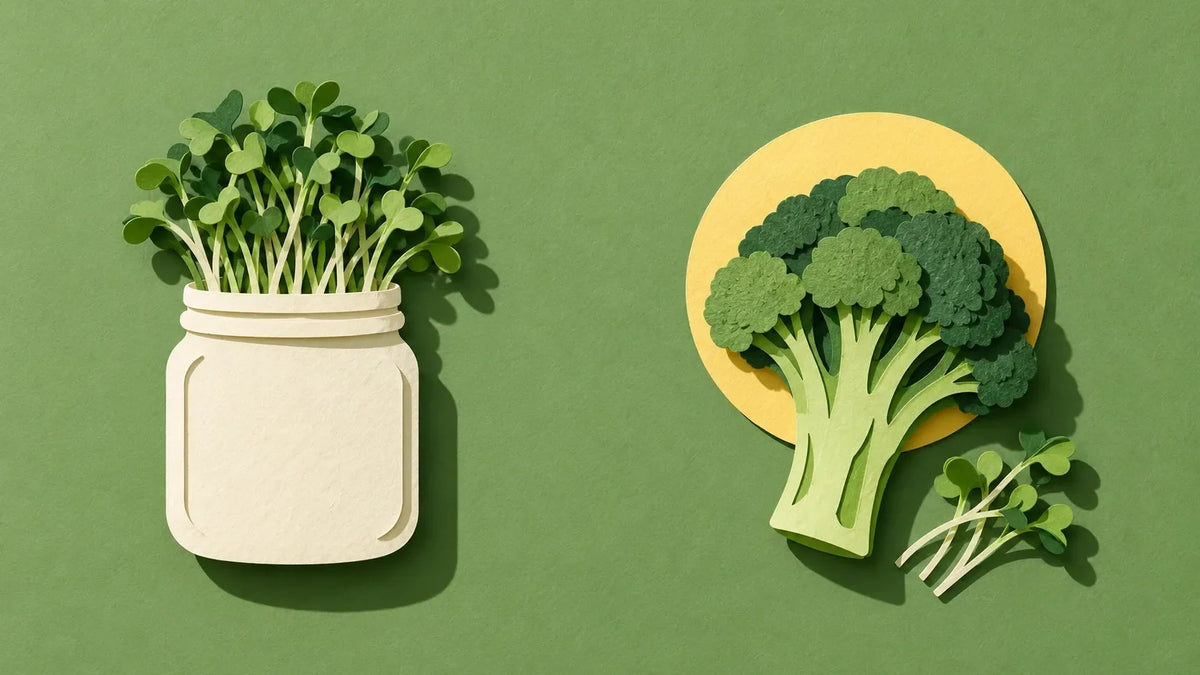
Sulforaphane—the powerful compound in broccoli sprouts—has become something of a health obsession. But the question that many enthusiasts face is simple: should you grow fresh broccoli sprouts yourself, or is a supplement more practical?
The answer isn’t one-size-fits-all. Both approaches have genuine advantages and disadvantages. In this comprehensive comparison, we’ll analyze the cost, convenience, potency, bioavailability, and practical considerations of supplements versus fresh sprouts so you can make the choice that fits your lifestyle.
Do broccoli sprouts have more sulforaphane than broccoli? They have far more of its precursor. In one analysis, 3-day-old sprouts of certain broccoli and cauliflower cultivars contained 10-100 times higher levels of glucoraphanin than the mature plants1.
Does cooking destroy sulforaphane? Cooking mostly stops it forming, because heat destroys myrosinase, the enzyme that makes it. In 8 men eating 200 g of broccoli, bioavailability was 37% raw and 3.4% cooked2. See the table.
Does a supplement need active myrosinase? Yes, to convert well. In human volunteers, sprouts or seeds with active myrosinase gave 3- to 4-fold more bioavailable sulforaphane than glucoraphanin delivered without it3. What to look for on a label.
Does mustard seed add sulforaphane to cooked broccoli? Yes, in one small study. Adding mustard seeds to cooked broccoli soup gave six times more sulforaphane reaching the colon in 11 people with ileostomies4.
Which is better, a sulforaphane supplement or broccoli sprouts? For most people, a supplement, because it is easier to keep up. Growing sprouts takes 10-15 minutes of daily upkeep, while a capsule is one action a day. Long-term adherence.

Understanding What You’re Comparing
Before we compare, let’s clarify what we’re actually evaluating. When we talk about “broccoli sprouts,” we mean the germinated seeds harvested at 3-5 days old, when glucoraphanin and myrosinase enzyme levels are at their peak. Mature broccoli florets contain far less sulforaphane.
When we talk about “supplements,” we mean commercial sulforaphane products derived from broccoli sprout extract, standardized for glucoraphanin content, and packaged in capsule or powder form.
These are fundamentally different products, which is why the comparison requires nuance.
Sulforaphane Content: Fresh Sprouts vs. Supplements
Here’s where the comparison gets interesting. Fresh broccoli sprouts contain impressive amounts of glucoraphanin, but the exact content varies dramatically.
Fresh Broccoli Sprouts: Variable Content
Fresh broccoli sprouts contain 10-35 mg of glucoraphanin per gram of sprouts, depending on:
- Seed variety: Some broccoli seed strains are naturally higher in glucoraphanin
- Growing conditions: Light exposure, temperature, humidity, and nutrient availability affect glucoraphanin synthesis
- Harvest timing: Sprouts at 3 days have different glucoraphanin levels than sprouts at 5 days
- Storage: Glucoraphanin degrades with time and light exposure after harvesting
- Source: Commercial sprout companies use different growing protocols than home growers
A typical serving of fresh broccoli sprouts (about 1/2 cup or 25-30 grams) contains approximately 250-1,050 mg of glucoraphanin. That sounds impressive until you realize the conversion to sulforaphane depends entirely on whether myrosinase is present and active.
Sulforaphane Supplements: Standardized Content
Quality sulforaphane supplements are standardized for glucoraphanin content, typically ranging from 20-50 mg of glucoraphanin per capsule. Some higher-potency supplements offer 80 mg per dose.
The major advantage: you know exactly what you’re getting. No guesswork about content variance.
Practical Sulforaphane Comparison
To achieve the 40-80 mg of daily sulforaphane that research studies typically use, you would need:
- From fresh sprouts: Approximately 1-2 cups of fresh broccoli sprouts daily (assuming 50% bioavailability and accounting for glucoraphanin-to-sulforaphane conversion)
- From supplements: 1-2 capsules daily, depending on glucoraphanin content per dose
So while fresh sprouts contain more total glucoraphanin per serving, you need to consume significantly larger quantities of fresh sprouts to achieve therapeutic doses used in research.
Bioavailability: The Critical Factor
Content doesn’t matter if your body can’t absorb and utilize it. This is where bioavailability becomes critical.
Fresh Sprouts: High Myrosinase, Variable Bioavailability
Fresh broccoli sprouts contain active myrosinase enzyme, which is the critical factor in converting glucoraphanin to sulforaphane during digestion. Theoretically, this gives fresh sprouts a bioavailability advantage.
But here’s the complication: myrosinase is destroyed by:
- Heating: Cooking fresh sprouts eliminates myrosinase entirely
- Stomach acid: Myrosinase is partially deactivated by gastric acid
- Inadequate pH: If stomach pH is too high or too low, myrosinase activity suffers
- Time: Myrosinase gradually degrades over the hours between eating and digestion
- Individual gut bacteria: Your microbiome affects myrosinase conversion efficiency
In practice, bioavailability of glucoraphanin from fresh sprouts ranges from 30-60%, depending on how you prepare them and your individual physiology.
The best approach: eat fresh sprouts raw (never cooked) to preserve myrosinase, and eat them immediately after harvesting for maximal enzyme activity.
Supplements: Optimized Bioavailability
Quality supplements use one of several strategies to optimize bioavailability:
- Preserved myrosinase: Some supplements preserve myrosinase enzyme through low-temperature processing, achieving bioavailability similar to fresh sprouts (50-60%)
- Stabilized sulforaphane: Other supplements include sulforaphane directly (not just the glucoraphanin precursor), which doesn’t require conversion and has higher bioavailability (70-90%)
- Enhanced delivery systems: Advanced formulations use encapsulation or other delivery methods that protect the compound and improve absorption (65-85%)
High-quality supplements actually achieve bioavailability in the 60-90% range—often higher than fresh sprouts, particularly if you account for individual variation and preparation factors.
Does cooking or active myrosinase change how much sulforaphane you get?
Both do, by a lot. Glucoraphanin is a relatively inert precursor. Sulforaphane forms when the enzyme myrosinase converts it3. The table lists what four studies measured. Each looked at a different food or preparation, so the rows are not a ranking of products.
| Source or preparation | What was measured | Result |
|---|---|---|
| 3-day-old sprouts vs. mature plants of the same cultivars | Glucoraphanin levels in the plants | 10-100 times higher in the sprouts1 |
| Raw vs. cooked broccoli, 200 g, 8 men | Sulforaphane bioavailability, from blood and urine | 37% raw, 3.4% cooked2 |
| Sprouts or seeds with active myrosinase vs. glucoraphanin without it, human volunteers | Bioavailability of sulforaphane | 3- to 4-fold higher with the active plant myrosinase3 |
| Cooked broccoli soup with vs. without mustard seeds, 11 people with ileostomies | Sulforaphane reaching the colon (measured in ileal fluid) | Sixfold more colon-available sulforaphane with mustard seeds4 |
Mustard seed is a source of myrosinase, which is why it can stand in for the enzyme that cooking removes4.
Cost Analysis: What Will You Actually Spend?
Let’s be honest about the financial reality of each approach.
Fresh Broccoli Sprouts: Costs and Hidden Expenses
Option 1: Buying Pre-Grown Sprouts
Pre-packaged fresh broccoli sprouts from grocery stores cost approximately $3.50-7.00 per package (typically 4-6 oz). To achieve therapeutic doses, you’d need 1-2 packages daily, costing $3.50-14.00 per day, or $105-420 per month.
Beyond cost, pre-packaged sprouts deteriorate quickly, and glucoraphanin content degrades within 2-3 days of harvesting.
Option 2: Growing Your Own Sprouts
Growing your own seems cheaper upfront but involves hidden costs:
- Initial equipment: Sprouting jar or tray ($10-40)
- Broccoli sprout seeds: $8-15 per pound; one pound produces many batches
- Water: Minimal cost
- Time: 10-15 minutes daily for rinsing and maintenance over 5-7 days per batch
- Failure rate: 10-20% of growing attempts fail due to contamination or poor conditions
- Mold risk: Improper growing conditions can produce contaminated batches that must be discarded
Actual cost-per-serving when growing your own: approximately $0.25-0.75 per batch (3-5 day growing cycle), or about $1-2 daily if consuming recommended amounts.
Home Growing Economics Over 30 Days:
- Seed cost: $2-5
- Equipment (amortized): $0.30-1.30
- Water and utilities: $0.50
- Failure batches (estimated): $0.50-1.00
- Total: $3.30-7.80 per month
Sulforaphane Supplements: Predictable Costs
Quality sulforaphane supplements range from $0.50-2.00 per daily dose, or $15-60 per month depending on brand and dosage strength.
Generic formulations cost $15-25/month. Premium brands with optimized delivery systems cost $45-60/month.
For comparison: premium home-grown sprouts ($3-8/month) are cheaper than budget supplements ($15+/month), but supplements are cheaper than buying pre-packaged sprouts ($105-420/month).
Convenience: Time, Effort, and Practicality
Cost is only one factor. Convenience and lifestyle fit matter tremendously.
Fresh Sprouts: The Convenience Reality
Growing sprouts requires:
- Daily commitment: Rinsing sprouts twice daily for 5-7 days
- Space: A dedicated shelf or jar kept in appropriate light and temperature conditions
- Attention to detail: Improper moisture or contamination can ruin an entire batch
- Ongoing planning: Staggering batches so you always have fresh sprouts available
- Preparation: Washing, draining, and preparing sprouts for consumption
- Eating immediately: Fresh sprouts taste peppery and slightly bitter; they’re not the most palatable way to consume a compound
- Spoilage management: Unused sprouts must be consumed within 3-5 days or discarded
For busy professionals, travelers, or anyone without interest in daily maintenance tasks, growing sprouts is genuinely inconvenient.
Convenience score: 2 out of 10 for people with limited time or space
Pre-Packaged Fresh Sprouts: More Convenient But Expensive
Buying pre-grown sprouts eliminates growing hassle but introduces cost and freshness problems:
- High cost: $3.50-7.00 per package
- Inconsistent availability: Not all grocery stores stock them; availability varies seasonally
- Rapid degradation: Glucoraphanin content drops significantly after 3 days
- Palatability: Still requires eating the raw sprouts
- Quantity required: You need 1-2 packages daily for therapeutic doses
Convenience score: 6 out of 10 (eliminates daily maintenance but introduces other logistical challenges)
Supplements: Maximum Convenience
Sulforaphane supplements require:
- One action per day: Take a capsule with a meal
- No preparation: No growing, washing, or food preparation
- No storage concerns: Capsules in a cool, dry place for months
- Perfect portability: Take them anywhere, no refrigeration needed
- No palatability issues: No taste to adjust to
- Consistent dosing: Same amount every day, no variability
- Compliance: Easy to remember and maintain long-term
Convenience score: 10 out of 10
For most people, this convenience factor is decisive. Long-term supplementation compliance is dramatically higher with supplements than with fresh sprouts, and inconsistent supplementation defeats the purpose.
Bioactive Compounds Beyond Sulforaphane
Fresh broccoli sprouts contain not just sulforaphane but the entire spectrum of compounds present in the plant: polyphenols, carotenoids, vitamins, minerals, and other phytonutrients. Some people argue this “whole food” approach is superior to isolated sulforaphane.
The Whole-Food Argument
It’s true that fresh sprouts contain additional compounds. However:
- Quantity is low: The amount of other compounds in a serving is modest
- Bioavailability varies: These compounds aren’t necessarily better absorbed or utilized than from other foods
- You can get them elsewhere: Eating diverse vegetables provides these compounds
- Research focus is sulforaphane: The compounds being studied in clinical trials are specifically sulforaphane, not the supporting phytonutrients
While whole-food arguments have merit in general nutrition, they don’t make a compelling case for fresh sprouts specifically, especially when you need to consume such large quantities for therapeutic doses.
Supplemental Advantage: Dose Consistency
Supplements provide standardized sulforaphane doses that match research protocols. This is actually an advantage if your goal is to achieve documented health benefits—you can take the dose that’s been proven effective in clinical trials.
Shelf Life and Stability Comparison
Fresh Sprouts: Rapid Degradation
Glucoraphanin content in fresh sprouts degrades over time, especially with:
- Light exposure: UV light degrades glucoraphanin
- Oxygen: Oxidation reduces compound stability
- Temperature fluctuation: Warm temperatures accelerate degradation
- Moisture: Excess or insufficient moisture promotes degradation
Fresh sprouts maintain reasonable glucoraphanin content for 3-5 days after harvest, then decline rapidly. After 7-10 days, glucoraphanin content may be 50% lower than fresh harvested.
Supplements: Excellent Stability
Quality supplements in dark, opaque, sealed containers maintain stability for 12-24 months when stored in cool, dry conditions. Some formulations remain stable for 3+ years.
This stability makes long-term supplementation practical. With fresh sprouts, you’re constantly managing freshness and degradation.
From Sproutly
Safety and Contamination Considerations
Fresh Sprouts: Contamination Risk
Raw sprouts have been associated with bacterial contamination (E. coli, Salmonella, Listeria) in both commercial and home-growing scenarios. While the risk is relatively low with proper growing practices, it exists.
Risk factors include:
- Contaminated seeds (source)
- Improper sanitation during growing
- Inadequate drainage or moisture control
- Non-sterile growing containers
- Extended growing times in improper conditions
People with compromised immune systems, pregnant women, and the elderly should be cautious with raw sprouts due to contamination risk.
Supplements: Third-Party Tested and Safe
Quality supplements undergo third-party testing for contaminants, pathogens, and purity. Manufacturers are required to follow GMP (Good Manufacturing Practices) standards, which include sanitation, quality control, and contamination prevention protocols.
Food safety is much higher with supplements than with home-grown or even commercial fresh sprouts.
Environmental and Sustainability Factors
Fresh Sprouts: Low Environmental Impact
Growing your own sprouts requires minimal resources: water, seeds, and basic equipment. The environmental footprint is extremely low, especially compared to purchasing pre-packaged sprouts (which require packaging, transportation, refrigeration).
Supplements: Moderate Environmental Impact
Supplements require agricultural resources for seed production, extraction, processing, encapsulation, packaging, and transportation. Environmental impact is higher than home-grown sprouts but often comparable to buying pre-packaged fresh sprouts from stores.
If environmental impact is a priority, home-grown sprouts win. But the difference isn’t massive compared to supplements.
Who Should Choose Each Option?
Considering all factors, here’s guidance on who benefits most from each approach.
Choose Fresh Broccoli Sprouts If You:
- Enjoy gardening or home food cultivation
- Have consistent time for daily maintenance (10-15 min/day)
- Live in a climate with stable indoor temperatures
- Have adequate growing space
- Prioritize cost-savings over convenience
- Enjoy the taste of fresh sprouts (or are willing to tolerate it)
- Value the sustainability aspect of home cultivation
- Want to ensure freshness by controlling growing conditions
Choose Supplements If You:
- Have limited time or space for sprout growing
- Travel frequently or have an unpredictable schedule
- Struggle with consistency (supplements make daily supplementation easier)
- Want guaranteed dosing and standardized content
- Prioritize convenience over cost
- Have concerns about food-borne contamination risk
- Want to match research-backed dosing protocols
- Prefer measured portions you can track easily
- Are concerned about supply consistency and availability
Consider Both If You:
Grow sprouts as your primary source but supplement with capsules during times when growing is interrupted (travel, illness, seasonal inability to maintain growing conditions). This hybrid approach offers cost-savings with consistency.
Quality Indicators: How to Choose Good Supplements
If you choose supplementation, quality matters enormously for bioavailability and effectiveness.
Look For:
- Glucoraphanin content listed: Good supplements show glucoraphanin content, not just vague “sulforaphane blend” claims
- Myrosinase enzyme: Premium supplements include myrosinase to enhance conversion
- Dark, opaque packaging: Protects from light degradation
- Third-party testing: Look for NSF, USP, or ConsumerLab verification
- Certificate of Analysis: Reputable companies provide this documentation
- Low excipient list: Minimal fillers and additives
- Cold-processed or low-temperature extraction: Indicates myrosinase preservation
- Opaque capsules: Better than clear capsules (which expose contents to light)
For more detailed guidance on evaluating supplements, see our Best Sulforaphane Supplement: Buyer’s Guide.
Growing Broccoli Sprouts: A Brief Guide for Those Interested
If you decide to grow your own, here’s a basic protocol.
What You Need:
- Broccoli sprout seeds (high-glucoraphanin variety if possible)
- A wide-mouth glass jar or sprouting tray
- Cheesecloth or sprouting screen
- Clean water
- A location with indirect light and stable temperature (60-75°F)
Basic Protocol:
Day 1-2: Soaking - Soak seeds in water for 12 hours, then drain
Day 2-5: Growing - Rinse sprouts twice daily, ensuring moisture but not waterlogged conditions. Provide indirect light.
Day 5-7: Harvest - When sprouts are 1-2 inches with visible seed leaves, harvest and rinse thoroughly
Day 7+: Consumption and Storage - Consume fresh immediately for maximum sulforaphane. Store in sealed container in refrigerator for up to 5-7 days.
Success Tips:
- Use high-quality, tested seeds from reputable suppliers
- Maintain proper moisture (damp but not waterlogged)
- Avoid direct sunlight (causes bitter taste) but provide some light for chlorophyll development
- Ensure good air circulation to prevent mold
- Sanitize equipment between batches with dilute bleach solution
- Stagger batches so you always have fresh sprouts available
For more details on broccoli sprout growing, see our What Is Sulforaphane? The Complete Science-Backed Guide, which includes cultivation basics.
The Hybrid Approach: Best of Both Worlds
Some people use a hybrid approach: grow sprouts when feasible, supplement with capsules when not. This offers:
- Cost savings from home-grown sprouts when time permits
- Consistency from supplements during busy periods
- Flexibility as life circumstances change
- Guaranteed daily intake regardless of sprout-growing success or failure
This is probably the most realistic long-term strategy for maintaining consistent sulforaphane intake.
What Does Current Research Actually Show?
Clinical studies demonstrating sulforaphane benefits have used either:
- Broccoli sprout extract supplements (most studies)
- Standardized sulforaphane supplements (some studies)
- Fresh broccoli sprout consumption (few studies)
Most research uses controlled supplement doses (40-80 mg sulforaphane daily) that would require 1-2 cups of fresh sprouts to achieve. The research is based on consistent daily dosing, which is much easier to achieve with supplements.
This doesn’t mean fresh sprouts don’t work—it means we have more evidence for the supplement approach, and matching research dosing is practical with supplements.
Long-Term Adherence: The Real Factor
Here’s an uncomfortable truth: supplements win on long-term adherence. People are far more likely to take a daily capsule consistently than to grow and eat sprouts daily for months or years.
Non-adherence is the biggest reason people don’t see health benefits from any supplement or health intervention. If growing sprouts is interesting and manageable for you, that’s great—but be honest about whether you’ll maintain that practice for years.
For most people, the realistic long-term choice is supplements, because consistency actually happens.
Making Your Decision
Ask yourself these questions:
- Time: Do I realistically have 10-15 minutes daily for sprout maintenance?
- Space: Do I have appropriate growing conditions (temperature, light, ventilation)?
- Cost: Is saving $50-100/month on supplements worth the time investment?
- Consistency: Will I maintain daily supplement intake for 12+ months?
- Taste: Can I tolerate eating raw broccoli sprouts regularly?
- Convenience: Do I travel, have an unpredictable schedule, or prefer simplicity?
If you answered “yes” to most time and space questions, growing sprouts may work for you. If convenience and consistency are priorities, supplements are the better choice.
The Bottom Line: Supplements vs. Fresh Sprouts
Fresh broccoli sprouts contain impressive sulforaphane content and active myrosinase, making them theoretically beneficial. However, achieving therapeutic doses requires significant daily consumption, and long-term adherence is challenging.
Quality supplements provide standardized dosing, proven bioavailability, superior convenience, and much higher long-term compliance rates. For most people, supplements are the more practical choice for consistent sulforaphane intake.
Growing sprouts is an excellent choice for those who enjoy cultivation and have consistent time to invest. But if consistency is the goal, supplements deliver reliability that fresh sprouts simply can’t match.
The best choice depends on your lifestyle, time availability, budget, and honest assessment of whether you’ll maintain daily sprout cultivation long-term. Most people benefit more from supplements—but if growing sprouts appeals to you, it’s a valid (and cheaper) alternative.
Read More From Sproutly
Want to learn more about sulforaphane, supplementation strategies, and how to maximize benefits? Check out these related articles:
- What Is Sulforaphane? The Complete Science-Backed Guide
- How to Maximize Sulforaphane Absorption: The Complete Bioavailability Guide
- Best Sulforaphane Supplement: Buyer’s Guide
- Sulforaphane for Gut Health
- Sproutly Sulforaphane Review
- Sulforaphane Supplements FAQ
- Sulforaphane for Acne and Skin Health
Frequently Asked Questions: Supplements vs. Fresh Broccoli Sprouts
How much fresh broccoli sprouts should I eat daily to match supplement doses?
To achieve 40-80 mg of sulforaphane (the dose used in most research), you’d need to eat approximately 1-2 cups of fresh broccoli sprouts daily. That’s a significant amount, especially as part of a long-term daily practice.
Do fresh sprouts lose potency after harvesting?
Yes. Glucoraphanin degrades over time, especially with light exposure and temperature fluctuations. Fresh sprouts maintain 70-80% of their glucoraphanin content for 3-5 days, then decline more rapidly. After 10 days, content may be 50% lower than freshly harvested.
Are home-grown sprouts safer than store-bought?
Both carry contamination risk, though home-grown allows you to control growing conditions. Store-bought sprouts may have lower risk if from commercial operations following food safety protocols, but this varies. For highest safety, grow your own with meticulous sanitation, or choose supplements (which are third-party tested).
Can I freeze fresh broccoli sprouts to extend shelf life?
Freezing preserves glucoraphanin but significantly reduces myrosinase enzyme activity. If you freeze sprouts, you lose the bioactive enzyme, reducing bioavailability. Better to eat fresh or use supplements for consistency.
Do supplements provide the same benefits as fresh sprouts?
Quality supplements provide sulforaphane in standardized, bioavailable doses. Bioavailability may actually be higher with optimized supplements (60-90%) than with fresh sprouts (30-60%), depending on the formulation. Benefits should be equivalent or superior if the supplement is high-quality.
What’s the most cost-effective way to get sulforaphane long-term?
Home-grown broccoli sprouts are cheapest at $3-8/month. Budget supplements are next at $15-25/month. Pre-packaged fresh sprouts are most expensive at $100-400/month. If cost is the primary concern and you have time, growing your own wins.
Can I use cooked broccoli sprouts if I don’t like the raw taste?
Cooking destroys myrosinase enzyme, preventing glucoraphanin-to-sulforaphane conversion. You’d get minimal sulforaphane from cooked sprouts. If you dislike the raw taste, supplements avoid this problem entirely.
How long do sulforaphane supplements stay potent?
Quality supplements in dark, sealed containers remain potent for 12-24 months when stored in cool, dry conditions. Check the expiration date on the bottle. Some formulations remain stable for 3+ years if storage conditions are ideal.
Is there any evidence that whole sprouts are better than isolated sulforaphane?
While fresh sprouts contain additional phytonutrients, clinical research specifically on sulforaphane benefits uses either sprout extract supplements or isolated sulforaphane. The evidence is for the sulforaphane compound itself, not the “whole food matrix” concept. Both approaches can be effective if properly dosed.
Can I grow other types of sprouts as a substitute for broccoli sprouts?
Other cruciferous sprouts (Brussels sprouts, cabbage, kale, radish) contain glucoraphanin and sulforaphane, but broccoli sprouts typically have the highest concentration. Radish sprouts are close in glucoraphanin content. For highest potency, stick with broccoli sprouts.
References
- Fahey JW, Zhang Y, Talalay P. Broccoli sprouts: an exceptionally rich source of inducers of enzymes that protect against chemical carcinogens. Proc Natl Acad Sci U S A. 1997;94(19):10367-72. PMID 9294217
- Vermeulen M, Klöpping-Ketelaars IW, van den Berg R, Vaes WH. Bioavailability and kinetics of sulforaphane in humans after consumption of cooked versus raw broccoli. J Agric Food Chem. 2008;56(22):10505-9. PMID 18950181
- Fahey JW, Holtzclaw WD, Wehage SL, et al. Sulforaphane bioavailability from glucoraphanin-rich broccoli: control by active endogenous myrosinase. PLoS One. 2015;10(11):e0140963. PMID 26524341
- Abukhabta S, Khalil Ghawi S, Karatzas KA, et al. Sulforaphane-enriched extracts from glucoraphanin-rich broccoli exert antimicrobial activity against gut pathogens in vitro and innovative cooking methods increase in vivo intestinal delivery of sulforaphane. Eur J Nutr. 2021;60(3):1263-1276. PMID 32651764
What customers say
About this article
Written by the Sproutly editorial team. Sproutly sells a broccoli sprout extract supplement, and this article links to its product page.
This is general information, not medical advice. Check your own label and ask a pharmacist or doctor about your situation.
These statements have not been evaluated by the Food and Drug Administration. This product is not intended to diagnose, treat, cure, or prevent any disease.
Keep reading
 Choosing a supplement
How to Choose the Best Sulforaphane Supplement: A Complete Buyer's Guide
 Gut health
Pumpkin Spice Latte Stomach Ache: What's in the Cup and Why It Hurts
 Gut health